

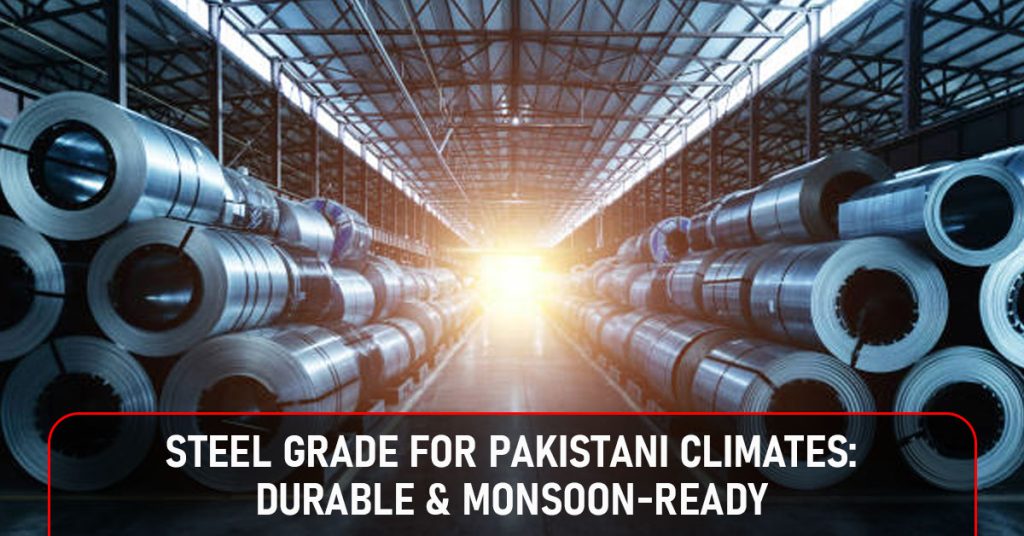
In a country where scorching summers, heavy monsoons, and humid coastal winds collide, building strength depends on more than concrete and design. It starts with the right steel that can withstand every condition. That is why choosing the right steel grade for Pakistani climates becomes a crucial decision that protects structures for decades and ensures lasting safety.
Across Pakistan, extreme weather pushes construction materials to their limits. Intense heat causes expansion, humidity speeds up corrosion, and heavy monsoon rains test the strength of every foundation. Yet many projects still use steel that is not designed for these conditions, leading to early damage, costly repairs, and safety risks. The solution lies in choosing materials built to handle these environmental challenges without compromising performance.
Whether you are a builder, developer, or homeowner, understanding how climate affects steel is essential for creating buildings that last. Keep reading as we explore how to choose the right steel grade for Pakistani climates and why this single choice can make your construction stronger, safer, and more reliable.

Pakistan’s diverse weather is more than a background challenge; it directly impacts how steel behaves in structures. Choosing the right steel grade for Pakistani climates is not just a technical decision but a safeguard for strength, safety, and long-term durability. Temperature changes, humidity levels, and seasonal shifts all influence how steel expands, contracts, and resists damage over time.
Extreme heat, common in many regions, can reduce tensile strength and accelerate material fatigue. Coastal humidity increases the risk of corrosion, weakening steel from the inside. Meanwhile, heavy monsoon rains create fluctuating moisture levels, which can cause internal stress and structural strain. Selecting a grade designed for these conditions ensures that steel maintains its strength and performance even under pressure.
Key environmental factors every builder must consider:
By choosing the right steel grade for Pakistani climates, builders can overcome these challenges with confidence. It ensures the material’s internal structure remains stable, delivering reliable performance for decades. Understanding these factors before construction begins is the foundation of creating buildings that stand strong against nature’s toughest tests.
Selecting the right steel grade for Pakistani climates is essential because every region faces unique environmental pressures. From scorching summers in the south to heavy monsoon rains in the north, the right choice ensures long-lasting strength, structural safety, and minimal maintenance. Below are the most suitable options for different conditions and why they work best.
In areas with extreme heat, steel must maintain strength despite constant thermal expansion and contraction.
In cities like Karachi or Gwadar, salty air and humidity increase corrosion risk. Choosing the right steel grade for Pakistani climates can significantly reduce long-term damage.
Frequent rainfall and fluctuating moisture levels require steel that can handle water exposure without losing integrity.
Regions with seismic activity demand steel that bends without breaking under pressure.
Selecting steel based on environment-specific needs is a strategic choice. It not only enhances structural performance but also reduces costs associated with repairs, corrosion treatment, and long-term maintenance.
The impact of climate on structural materials is far greater than most builders realize. Selecting the right steel grade for Pakistani climates is not just about strength — it is about ensuring the material can adapt and perform in the country’s demanding weather conditions. From temperature swings to heavy rainfall, each environmental factor influences steel’s behavior, durability, and overall lifespan.
When temperatures rise and fall drastically, steel expands and contracts.
In regions with high humidity or heavy rain, moisture is a constant threat. Choosing the right steel grade for Pakistani climates ensures resistance to water damage.
Structures near the coast face higher risks due to salt-laden air.
Heavy rains and monsoon cycles can stress steel components in foundations and frameworks.
Understanding how climate influences material performance helps builders make smarter decisions. With the right steel grade for Pakistani climates, projects achieve longer service lives, greater safety, and reduced maintenance costs.

When clients are choosing the right steel grade for Pakistani climates, we ensure that every bar is built through a precise, technology-driven process tailored to handle heat, humidity, and monsoon stress. At Pak Iron, our production facility is fully automated, using continuous casting, advanced re-rolling, and strict temperature control to deliver materials that perform reliably in local environmental conditions.
Our facility includes two Inductotherm furnaces (8-ton & 12-ton) that feed into continuous casting, ensuring consistent billet composition. Our rebar mill uses three-speed stands and Siemens PLC control to ensure every bar is dimensionally perfect, minimizing defects caused by thermal stress.
Also, we operate a 150-foot cooling bed with an automated rotary shear. This bed is long and precisely controlled to allow each bar to cool uniformly. Every batch is bundled, tagged, and traceable back to its production source.
Key engineering features for climate resilience:
By combining these technologies, Pak Iron delivers steel that meets real-world climate demands and provides confidence to builders when choosing the right steel grade for Pakistani climates.
We build climate resilience into every structural solution because choosing the right steel grade for Pakistani climates demands more than generic production. At Pak Iron, we are a third-generation manufacturer. We moved from just supplying billets to running a state-of-the-art automatic mill that produces deformed steel bars and structural steel built for harsh weather, humidity, and monsoon effects. Our facility sits in Islamabad / Rawalpindi, where we understand extreme temperature swings and coastal moisture firsthand.
To ensure consistent quality and suitability under local climate challenges, we use advanced Siemens automation and two Inductotherm USA furnaces (8-ton & 12-ton) to control heating. Billets are produced via continuous casting to achieve homogeneous composition. Our 150-foot cooling bed with automated rotary shear ensures steel cools uniformly. Every batch is bundled, tagged, and completely traceable. This technology ensures that steel made here endures humid air, heat, and frequent rain without losing strength.
Services we provide to support climate-adapted construction:
When you commit to choosing the right steel grade for Pakistani climates, our engineering, technology, and service work together so your buildings resist wear, decay, and climate stress — delivering strength, safety, and trust.
Building long-lasting infrastructure is not just about design or budget. It starts with the materials that hold everything together. In a country where scorching summers, heavy monsoons, and coastal humidity constantly test structural integrity, choosing the right steel grade for Pakistani climates becomes a critical decision. It directly impacts how buildings perform over decades, how often they need repairs, and how safely they protect the people inside.
At Pak Iron, we combine decades of experience with advanced technology to produce steel that stands up to Pakistan’s unique environmental conditions. Our manufacturing process, from controlled furnace temperatures to automated cooling beds and ISO-certified testing, ensures every rebar and structural solution is engineered for strength, corrosion resistance, and durability. This means fewer maintenance costs, better seismic performance, and a stronger foundation for the nation’s future.
If you are planning housing developments, bridges, commercial towers, or industrial plants, now is the time to invest in steel that’s built to last. Contact our team today to discuss your project needs and discover how our climate-ready solutions can give your structures the strength and reliability they deserve. Together, we can build infrastructure designed to thrive in Pakistan’s challenging environments.
Pakistan’s climate includes extreme heat, heavy monsoons, and coastal humidity. Selecting the right steel grade ensures buildings remain strong, resist corrosion, and perform reliably under these conditions.
High temperatures, moisture, and salt exposure can weaken low-quality steel over time. Climate-ready steel is engineered to resist these factors, maintaining its structural strength and reducing long-term maintenance.
Grade 60 rebars and specialized structural steel with enhanced corrosion resistance are ideal. These grades offer higher yield strength and better performance in humid, salty, or wet environments.
Our steel is produced with Siemens automation, Inductotherm furnaces, and controlled cooling processes to ensure consistent quality. Each batch undergoes lab testing and certification to guarantee climate-ready performance.
Yes. Pak Iron provides custom specifications for residential, industrial, and infrastructure projects, including those in coastal or monsoon-prone regions, ensuring your construction is built to last.
You can reach out to our team through the contact page on our website. We’ll help you select the right steel grade based on your project’s location, design, and durability needs.